
What if the most important security decision in a DeFi transaction happens before the swap itself? A user may focus on the quoted exchange rate, network fee, or bridge route, yet the lasting authority granted to a smart contract can matter just as much. Token approvals determine what a contract may do with an asset; wallet security determines whether that permission is understood and controlled; cross-chain swaps multiply the number of contracts, networks, and assumptions involved. Treating these as separate topics creates blind spots. A safer mental model is to view them as different stages of one authorization system.
This matters particularly for US-based DeFi users moving between decentralized exchanges, lending markets, and cross-chain applications. The objective is not to eliminate every risk—no wallet interface can do that—but to make the permission being granted visible, bounded, and reversible wherever possible. A browser wallet can help interpret transaction details, but the user still makes the final authorization decision.
Token approvals are permissions, not transactions
Most ERC-20 tokens use an allowance mechanism. When a user approves a contract, the token contract records that a designated spender may transfer up to a specified amount from the user’s balance. The approval does not itself exchange tokens. It creates an authorization that a later transaction can use, often without asking the user to approve the token movement again.
This distinction explains both the convenience and the risk. A decentralized exchange may request approval before a swap because the exchange contract needs permission to pull the input token. If the allowance is limited to the amount being traded, the authority is relatively narrow. If it is set to an effectively unlimited value, future swaps may be cheaper and faster from a user-experience perspective, but the permission remains available until it is reduced or revoked.
The non-obvious point is that approval risk is not identical to application risk. A contract can be reputable and still become vulnerable later. A user can approve the correct token but the wrong spender. A malicious or compromised spender may be able to use an existing allowance even when the wallet owner is not actively interacting with the application. Approval management therefore concerns the duration and scope of authority, not simply whether a transaction is legitimate at one moment.
What an approval review should establish
Before confirming an approval, the user should be able to answer three questions: which token is being authorized, which contract receives spending authority, and how much authority is granted. A fourth question is often overlooked: how long should that authority remain useful? In practice, users frequently approve a token once and forget that the permission may persist after the trade, after the application is no longer used, or after the user has moved to a different strategy.
Wallet interfaces that simulate transactions and identify likely contract behavior can improve this review process. They cannot guarantee that a contract is safe, because simulations depend on current state and may not capture every future execution path. Still, making the spender and requested permission legible is materially better than treating every confirmation as an opaque prompt.
Wallet security is an authorization discipline
Wallet security is often reduced to protecting a seed phrase or hardware device. Those controls are essential, but they address only one layer: who can sign. DeFi users also need to manage what a signed transaction authorizes. A wallet can remain under the owner’s control while an overly broad allowance, dangerous permit, or deceptive contract interaction creates avoidable exposure.
This is why transaction review should be considered a form of access control. A signature is not merely a digital equivalent of clicking “submit.” Depending on the transaction, it may authorize a token transfer, change a spending allowance, delegate voting power, or provide a permit that a contract can use later. The practical security question is not only “Do I recognize this website?” but also “What new capability will this signature create?”
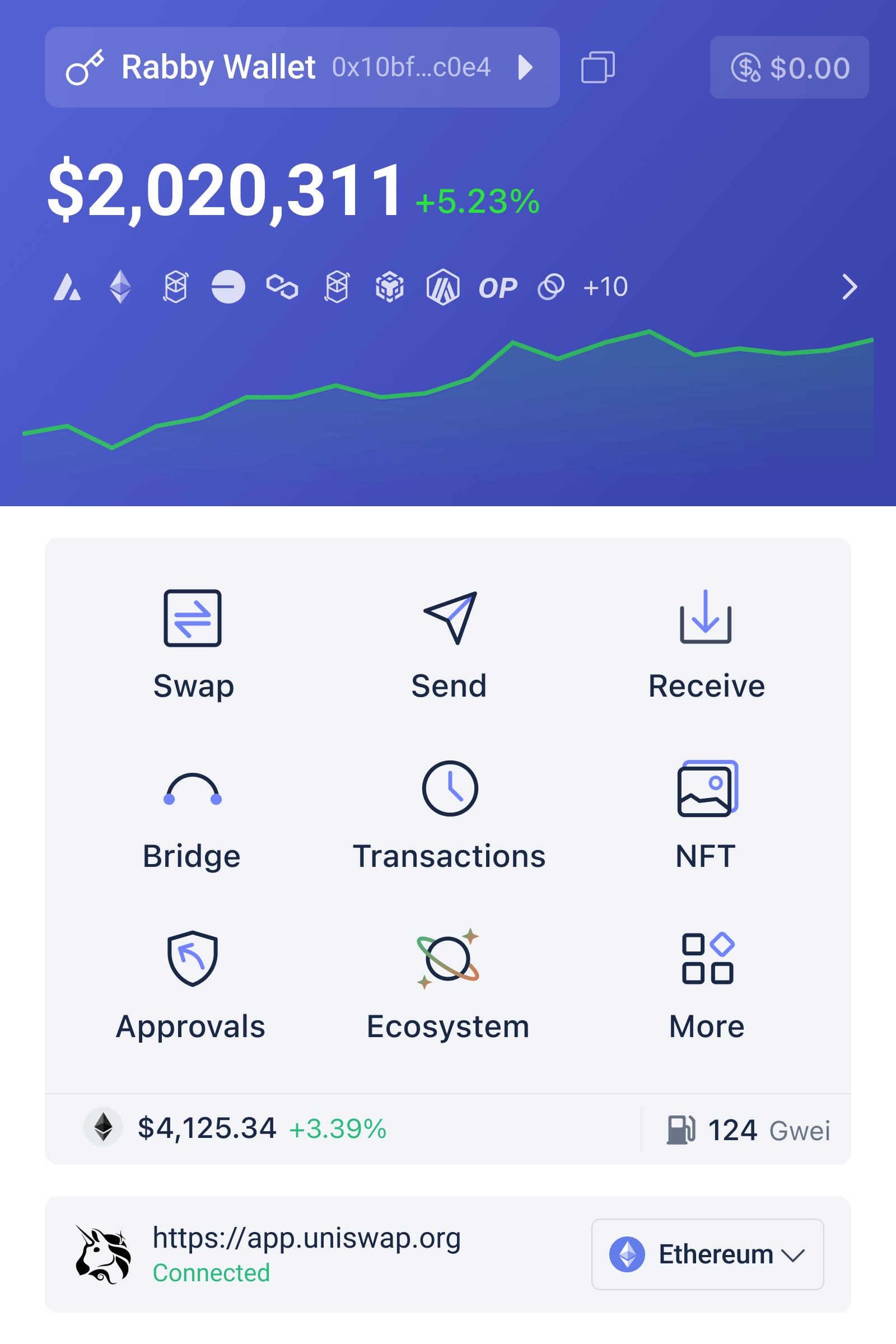
Installing a wallet should also be treated as a supply-chain decision. Users should obtain software through a source they can verify and check that the extension publisher, browser listing, and requested permissions are consistent. Those seeking the rabby wallet extension should still verify the official installation path and avoid search advertisements, unsolicited messages, and cloned pages. A genuine wallet cannot compensate for a fake download or a compromised recovery phrase.
There is a useful separation between custody and interaction safety. A hardware wallet can protect private-key signing, but it does not automatically make a malicious transaction harmless. Conversely, a software wallet with strong simulation and warning features may provide valuable context, but it cannot protect funds if the recovery phrase is exposed. Robust practice combines key protection, transaction interpretation, allowance hygiene, and careful website selection.
Why cross-chain swaps increase the reasoning burden
A cross-chain swap is not a single universal operation. Depending on the route, it may involve a source-chain token approval, a swap contract, a bridge or messaging system, a destination-chain execution, and one or more liquidity providers. Some systems lock an asset on one chain and release or mint a representation on another. Others use liquidity pools or market makers to deliver an asset on the destination chain. The user experience may look like one swap, while the underlying authorization graph is considerably longer.
Each additional component introduces a separate trust or failure assumption. The source token must be approved to the correct spender. The route must identify the intended destination asset and recipient. The bridge or messaging mechanism must process the cross-chain instruction correctly. Liquidity must be available at an acceptable price. Network congestion, failed messages, slippage, or changes in contract state can affect the outcome even when the user signs exactly what was displayed.
Cross-chain activity also creates a common misconception: the destination asset is not necessarily the same economic object as the asset held on the source chain. It may be a wrapped or bridged representation whose value depends on redemption, liquidity, and the bridge’s operating model. The interface may show familiar ticker symbols, but symbol similarity is not proof of identical contract risk, liquidity, or redemption conditions.
For this reason, a cross-chain review should examine the complete route rather than the headline exchange rate. Confirm the source network, destination network, input token, output token contract where practical, recipient address, minimum received amount, fees, and deadline. On the source chain, inspect approvals. On the destination chain, verify that the received asset is the one intended and that it can be used in the applications the user expects.
A practical framework for safer approvals and swaps
A useful framework is to divide the decision into four stages: identify, bound, execute, and clean up. First identify the application, spender, networks, tokens, and destination address. Then bound the transaction by limiting the allowance, setting a reasonable slippage tolerance, and avoiding unnecessary permissions. Execute only after reviewing the wallet’s interpretation and the application’s quoted parameters. Finally, clean up by checking whether a temporary approval should be reduced or revoked.
Limited approvals are not always the best choice for every user. They can require additional transactions, increase fees, and create friction when network conditions are expensive. Unlimited approvals may be operationally convenient for a frequently used and well-understood application, but they create a larger residual exposure if the spender is compromised or the user forgets about the permission. The decision is therefore a trade-off between convenience, transaction cost, and the amount of authority left outstanding.
Revocation is also not a cure-all. Reducing an allowance requires an on-chain transaction and may cost network fees. It does not reverse transfers that already occurred, repair a compromised private key, or make a malicious application trustworthy. Revocation is best understood as reducing future authority. It is most useful when paired with regular monitoring and a habit of checking permissions after experimenting with unfamiliar protocols.
One practical improvement is to separate experimental funds from long-term holdings. A dedicated wallet or account for new protocols can limit the consequences of an incorrect approval or deceptive interaction. This arrangement does not remove bridge or smart-contract risk, and it introduces its own operational burden, but it narrows the blast radius. For larger positions, users may also prefer hardware-backed signing and a deliberate review process rather than rapid confirmation from a mobile or browser prompt.
Where wallet warnings help—and where they stop
Wallet simulations and risk signals are valuable because they translate low-level contract calls into a more understandable description of likely effects. They can flag suspicious recipients, unexpected asset movements, or a mismatch between the user’s apparent intention and the transaction data. That is a meaningful usability improvement, especially for people who cannot read raw calldata.
Yet warnings are probabilistic, not guarantees. A benign-looking transaction can interact with a vulnerable contract. A legitimate protocol can change its contracts or front end. A simulation may not reflect a future state, a price movement, or a cross-chain message that has not yet been delivered. Users should treat warnings as evidence to evaluate, not as a substitute for judgment.
The strongest near-term security improvements are therefore likely to come from better permission visibility, clearer distinctions between approvals and asset transfers, and more consistent cross-chain route disclosure. If interfaces make durable authority as prominent as immediate transaction output, users may become less likely to confuse “the swap succeeded” with “the application no longer has permission.” That distinction is small in wording but large in consequence.
Frequently asked questions
Should I always revoke token approvals after a swap?
Not necessarily. Revoking can reduce residual exposure, but it costs an on-chain transaction and may be inconvenient for an application you use frequently. Consider revoking or reducing approvals for unfamiliar, rarely used, or high-risk contracts, while recognizing that revocation cannot undo transfers that already happened.
Does using a hardware wallet make cross-chain swaps safe?
No. A hardware wallet protects the signing key and makes unauthorized signing more difficult, but it will still sign a harmful transaction if the user approves it. Cross-chain safety also depends on the spender, route, bridge assumptions, destination asset, slippage, and the accuracy of the transaction review.
What is the most important approval detail to check?
Check the spender address and the allowance amount together. An approval is risky when the user does not know which contract receives authority or when the amount is much larger than the intended use. Also remember that the permission may persist after the immediate transaction is complete.
The central lesson is simple but deeper than “be careful.” DeFi security is largely the management of authority across time. A swap changes balances once; an approval can create a continuing capability. Cross-chain routes extend that capability across multiple systems with different assumptions. Users who identify each authority, bound it where practical, review the full route, and remove obsolete permissions are not eliminating uncertainty. They are making uncertainty smaller, more visible, and easier to manage.